Matrix Analysis: The Deep Dive in Note-Taking Market
The Matrix
Look in different views to understand the products and market
Focus on "user experience"

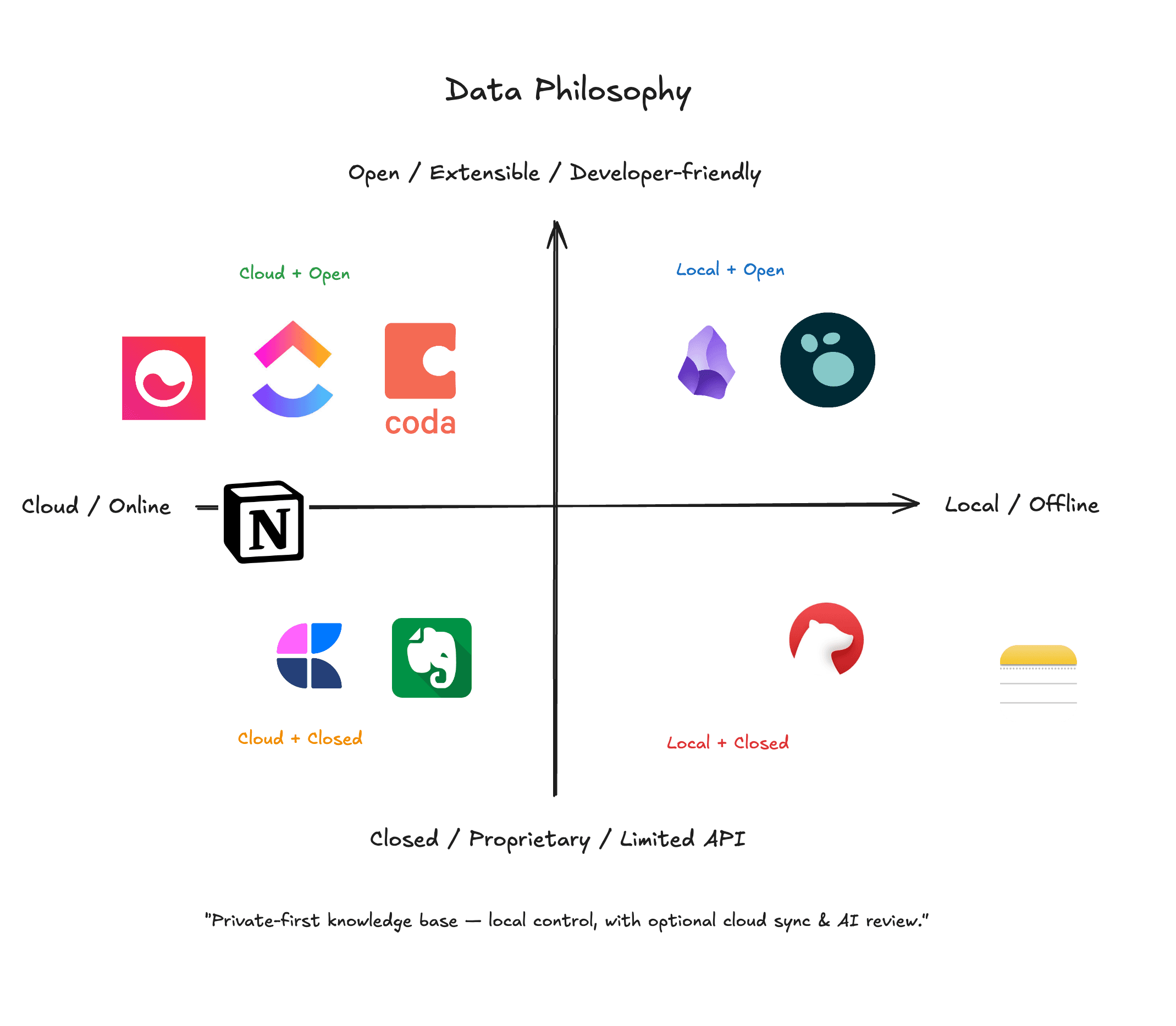
Focus on "Data Philosphy"
Focus on "Cognitive Experience"

Dimension | GOODA’s Ideal Quadrant | Strategic Differentiator |
|---|---|---|
User Experience | Simple + Flexible | Zen interface, minimal but intelligent |
Data Philosophy | Local + Open Hybrid | Privacy-first, sync optional, AI-enabled |
Cognitive Experience | Reflection + Individual | Knowledge “decluttering” + active recall system |
A great product usually has clear value position, so matrix not only help me find your position alos have understanding with other competitors.
The optimized prompt for matrix analysis
System Role:
You are a strategic product analyst and startup mentor.
Your goal is to generate insightful, visually clear 2×2 matrixes that compare competitors and identify white-space opportunities for a given market or product idea.
Each matrix must have meaningful X and Y axes with distinct strategic logic — not redundant dimensions.
User Input Example:
“Analyze the note-taking and knowledge management market (Notion, Obsidian, Bear, Evernote, Coda, etc.) for my product GOODA, which focuses on minimal, reflective note-taking with AI decluttering and review features.”
Al Task:
Generate three distinct 2x2 matrices for competitor and product analysis.
Each matrix must:
Define a unique perspective (UX, data philosophy, cognitive or business value, etc.).
Clearly label X and Y axes with opposing dimensions.
Provide quadrant interpretations (what each area represents).
Place real competitors in appropriate quadrants.
Identify the ideal position for the target product (e.g., GOODA).
Visualize each matrix in plaintext ASCII chart format for readability.
End with a summary table highlighting:
Market white-space
Strategic differentiation opportunities
Suggested product positioning tagline
Output Format Example:
Then produce
Example Quick Use (You Paste This to AI)
Prompt:
Generate three 2×2 competitor analysis matrixes for the personal knowledge management and note-taking market.
My product is called GOODA, focusing on minimal interface, AI decluttering, and reflective learning.
Use the above framework to produce ASCII-style visualizations, competitor placement, and a final summary table of GOODA’s strategic differentiation.
GOODA
Copyright by GOODA 2025